
 Harikrishnan Varieth


Virtual Twin Patients: What Indian Doctors Can Learn from the Future of Surgical Planning
A Look Back at What Really Mattered in Clinics This Year
30 Dec 2025
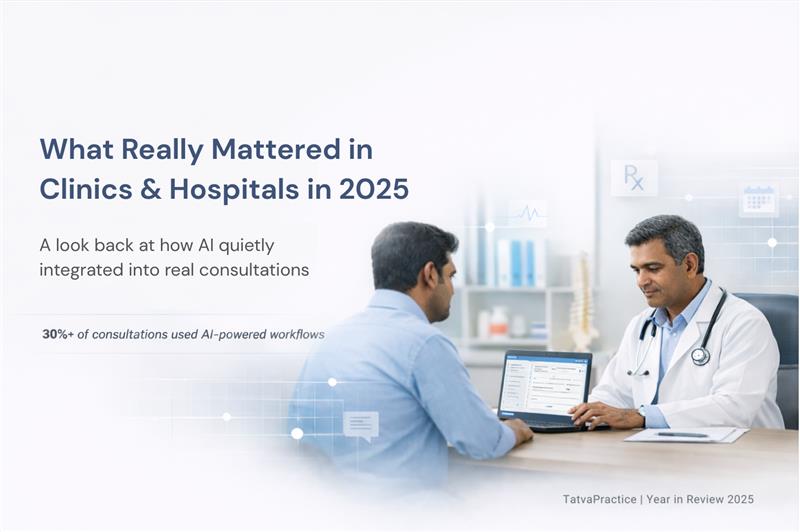
As 2025 comes to a close, one signal stood out clearly across clinics and hospitals: AI didn’t remain experimental. It became part of everyday clinical practice.
On TatvaPractice, AI-assisted workflows quietly moved into the core of consultations, not as a feature doctors had to ‘use’, but as support that fit naturally into how they already work.
By the end of the year, roughly one out of every three consultations involved at least one AI-powered workflow, spanning prescriptions, documentation, symptom capture, and appointment handling.
That number matters not because it sounds impressive, but because of where this adoption happened: in day-to-day practice, with real patient throughput.
2025 at a glance
- Used by 1,000+ clinics and hospitals through the year
- 3.8 million+ and 2.5 million+ of patient appointments and consultations were managed digitally
- Over 30% of all consultations used at least one AI-powered workflow
That number matters. Not because it sounds impressive, but because it shows where AI is finally earning a doctor’s trust: inside real consultations, under real patient load.
From Experimentation to Everyday Use
Doctors don’t adopt technology because it’s new. They adopt it when it supports the consultation; without interrupting it. In 2025, AI on TatvaPractice stopped being an extra step or an added screen. It began operating inside the consultation itself.
- Prescriptions were structured as doctors spoke.
- Symptoms were captured before consultations began.
- Administrative coordination required less back-and-forth.
- Doctors weren’t ‘using AI’ as a task.
- They were practising medicine while AI handled the structure around it.
Why AI Adoption Looked Different This Time
This shift wasn’t about saving a few seconds. It addressed problems doctors have lived with for years:
- instructions getting misinterpreted
- handwritten notes losing clarity over time
- fragmented records across OPD, IPD, billing, and pharmacy
- clinical history scattered across visits
AI-powered documentation brought consistency and continuity into records without asking doctors to change how they think or practice.
- Prescriptions became clearer.
- Notes became more structured.
- Clinical data became easier to retrieve and trust.
For doctors, this wasn’t just efficiency. It was confidence in their records.
Where AI Found Its First Real Users
Adoption wasn’t uniform, and that was the insight.
AI workflows saw the strongest uptake in high-volume OPD specialties such as general medicine, internal medicine, gynaecology, cardiology, and dermatology. These are settings where repetition is high and small inefficiencies quickly compound.
Voice-led workflows gained traction in specialties where doctors tend to explain and reason aloud, particularly physician-led practices and cardiology, allowing documentation without breaking clinical flow.
Early use of AI-assisted symptom collection and appointment handling also appeared where pre-consult context and coordination matter most.
In short, AI gained acceptance first where clinical pressure was highest and practical value was immediate.
From Documentation Burden to Clinical Asset
One of the quieter shifts in 2025 was how doctors began to value structured digital records, not for compliance, but for care continuity. When prescriptions, symptoms, admission notes, and discharge summaries followed a consistent structure:
- past history was easier to recall
- handovers became cleaner
- follow-ups felt more informed
- IPD documentation carried less end-of-day pressure
AI didn’t just generate data. It made records usable.
Looking Ahead
As we move into 2026, this insight shapes everything we’re building at TatvaPractice:
- deeper AI-powered documentation
- stronger clinical intelligence across visits
- better interoperability across OPD, IPD, billing, and pharmacy
- AI tools that reduce cognitive and administrative load — not increase it
The goal remains simple:
AI that doctors trust.
Records that doctors rely on.
Systems that finally work the way clinics do.
2025 showed us this future is already underway. We’re building what comes next, with doctors, and for doctors.
Recent Blog
- A Look Back at What Really Mattered in Clinics This Year
- Virtual Twin Patients: What Indian Doctors Can Learn from the Future of Surgical Planning
- Can AI Deskill Doctors? The Lancet Warns of Risks – Here’s How You Stay in Control
- What India’s AI Push Means for Small Clinics
- Top 5 Myths Doctors Believe About Going Digital and Why They’re Wrong
Archives
Categories
- Asthma (20)
- Diabetes (15)
- Fatty Liver (20)
- High Blood Pressure (2)
- High cholesterol (2)
- Hypertension (2)
- Insulin Resistance (1)
- Obesity (8)
- PCOS (6)
- TatvaPractice (19)
Let’s Connect
Quick contact